
Ad Budget Optimization: Practical Methods That Cut Waste
Learn practical ad budget optimization methods that cut wasted spend across Meta, Google, and TikTok with automated rules, tests, and guardrails.
- ad budget optimization
- paid media
- ad spend
- budget allocation
- ad operations
Paid media now takes 30.6% of total marketing spend, while related benchmarks estimate that 26% of marketing budgets and 30.6% of digital ad spend are wasted through poor allocation, weak targeting, low-quality placements, tracking errors, and redundant tools, according to industry research on marketing budget planning. That makes ad budget optimization less like a quarterly finance exercise and more like operating a live control system.
The practical question isn’t, “Which campaign had the best ROAS last month?” It’s, “Where should the next dollar go, what evidence supports that move, and what guardrail stops the decision from becoming expensive overreaction?” The answer requires allocation rules, minimum data thresholds, pacing checks, automated triggers, and a review process that works across Meta, Google Ads, and TikTok.
Table of Contents
- Why Ad Budget Optimization Matters More Than Ever
- Setting the Right Allocation Framework
- Data Thresholds That Prevent Costly Mistakes
- Automated Rules and Guardrails for Spend Control
- Pacing and Reallocation Cadence That Works
- Allocating When Attribution Is Messy
- Your Ad Budget Optimization Checklist
Why Ad Budget Optimization Matters More Than Ever
Paid media has become a large enough part of the marketing budget that small inefficiencies spread quickly. When a team leaves money in an underperforming audience, placement, or creative variant, the problem isn’t limited to one ad set. The same mistake can repeat across platforms, markets, and product lines.
The waste estimates are also a warning about where optimization work belongs. Misallocated spend, poor targeting, tool redundancy, tracking errors, and low-quality placements can all look different in platform reports, but they create the same operational outcome: budget moves away from campaigns with stronger marginal potential. For global advertisers, the practical task isn’t merely raising ROAS on a few winners. It’s reducing leakage across the whole media mix.
Practical rule: Optimize the next dollar, not last month’s headline metric.
Ad budget optimization is the ongoing practice of deciding how much each campaign, ad set, audience, placement, and platform should receive as conditions change. It combines performance signals with constraints such as target CPA, contribution margin, delivery requirements, learning needs, and measurement confidence.
That definition matters because the old monthly spreadsheet review is too slow for many accounts. Creative fatigue, audience saturation, auction pressure, and tracking changes can alter performance before the next scheduled meeting. A senior buyer may still review monthly totals, but daily or near-daily monitoring catches pacing problems and material anomalies earlier.
The operating system described here has six parts: protect proven spend, reserve controlled room for expansion, wait for sufficient evidence, automate repeatable controls, reallocate on a defined cadence, and use blended measurement when attribution is incomplete. The final section turns those principles into a Monday checklist.
Setting the Right Allocation Framework
A useful starting point is the 70:20:10 allocation framework. The model places 70% of spend in proven tactics, 20% in emerging opportunities, and 10% in experiments, as described in this guide to marketing spend optimization. It works because it protects the account’s base while preserving room to discover the next source of efficient growth.
The labels need operational definitions:
- Proven spend supports campaigns, audiences, keywords, and creative patterns that consistently meet the account’s target economics.
- Expansion spend tests adjacent opportunities, such as new creative angles, lookalike audiences, keyword themes, placements, or markets that resemble existing winners.
- Experimental spend funds ideas without an immediate return requirement. The test still needs a hypothesis, budget limit, owner, and decision date.
| Account Stage | 70% Proven | 20% Expansion | 10% Experiments |
|---|---|---|---|
| Early account | Stabilize the strongest measurable signals | Test adjacent audiences and creative | Validate tracking and new concepts |
| Growing account | Scale repeatable campaigns carefully | Expand markets, formats, and themes | Test larger strategic bets |
| Mature account | Protect efficient, incremental demand | Find new pockets before saturation | Explore channels and measurement methods |
A framework shouldn’t become a cage. An account with weak conversion tracking may need more controlled validation before treating a campaign as proven. A mature account with reliable data may justify a larger expansion envelope because the main risk is saturation, not discovery.
Use an optimization envelope rather than changing the entire budget at once. For a hypothetical monthly budget, assign a defined portion to planned reallocations and require a documented reason for each move. The envelope can cover weekly shifts, creative tests, seasonal opportunities, and corrective action when pacing or efficiency breaks.
Revenue-share benchmarks provide context for the total spending envelope. One benchmark puts marketing spending at 7.7% of company revenue in 2024, while other guidance places typical budgets around 9.4% of revenue and B2B budgets around 8% to 11%, as summarized in the same marketing spend optimization guidance. For broader measurement decisions, operations leaders can also use this guide to MMM for operations leaders to understand how channel-level signals fit into a business-wide allocation model.
Data Thresholds That Prevent Costly Mistakes
The most common budget mistake is acting on a result before it has earned confidence. A campaign can look excellent after a few conversions and then collapse when the audience, auction, or conversion mix changes. The reverse happens too. A promising campaign gets paused because its first day was expensive.
Use thresholds as guardrails, not goals. An independent benchmarking guide recommends at least 1,000 impressions for CTR analysis, 30 posts for engagement benchmarks, 90 days for trend analysis, and 100 or more clicks or about $500 or more in spend per segment before bid adjustments. It also recommends at least four weeks of performance data and 100 conversions per channel before major budget reallocation, as detailed in this social media benchmarking guide.
The thresholds should match the decision:
- For a creative CTR decision, wait until the ad has enough impressions to make the comparison meaningful.
- For a CPA decision, evaluate conversion volume, conversion lag, and the selected attribution window.
- For a channel reallocation, use a longer window than you would for a single-ad pause.
- For trend analysis, separate a short-term anomaly from a sustained movement.
A practical workflow starts by normalizing platform data. Align spend dates, conversion windows, currency, naming, and funnel events before comparing Meta with Google Ads or TikTok. Then compare like with like, such as prospecting against prospecting and branded search against branded search.
A threshold protects a decision from noise. It doesn’t prove that the decision is correct.
Two campaigns can show the same CPA and carry very different levels of reliability. One may have generated that CPA from a small number of conversions, while the other has a much deeper conversion history. The displayed average is identical, but the second campaign gives you a stronger basis for reallocating budget.
Review performance frequently, but separate review from action. The same independent guidance notes that advertising tests can require higher confidence than the commonly used 95% threshold, with high-variance campaigns sometimes calling for 99% confidence. Weekly review is useful, but material shifts should wait until the evidence supports them.
For platform execution, use consistent date ranges and conversion windows in Meta Ads Manager and Google Ads. Annotate budget changes, creative launches, landing-page changes, and tracking incidents. Without those annotations, a performance shift can look like a media result when it was caused by an implementation change. Teams can use this ad performance metrics reference to keep the measurement vocabulary consistent across accounts.
Automated Rules and Guardrails for Spend Control
Automation should catch predictable waste before a buyer has to find it manually. It shouldn’t make unrestricted decisions from one noisy metric. Every rule needs four fields: trigger, threshold, action, and review owner.

Start with pause rules that reflect unit economics. A target CPA ceiling can trigger a warning before it triggers a pause, giving the buyer time to check conversion lag, spend volume, audience overlap, and tracking quality. A second rule can cap daily spend while an ad set remains in the learning phase or lacks enough conversion evidence.
Budget controls should also account for customer behavior. Frequency limits need to reflect how often a customer can reasonably purchase. A subscription product, an emergency service, and a seasonal retailer shouldn’t use the same fatigue logic.
Useful rule categories include:
- Efficiency alerts: Notify the owner when CPA, ROAS, or cost per qualified lead moves outside the accepted range.
- Pacing alerts: Flag campaigns that are underdelivering or spending too quickly against the flight plan.
- Creative alerts: Identify rising frequency alongside declining engagement or conversion quality.
- Redistribution suggestions: Recommend moving budget from weak, sufficiently tested ad sets toward stronger marginal opportunities.
- Change monitoring: Record every automated action and require a human review for unusual or high-impact changes.
Platform-native automation has a role. Meta automated rules, Google Ads scripts, and TikTok delivery controls can handle repetitive monitoring, while a shared Slack or email alert keeps the operating team aware. The rules should be documented in a playbook rather than scattered across individual accounts. This ad operations tools resource can help teams map the software layer around those workflows.
Don’t automate a threshold you haven’t validated. If the account has delayed conversions, a short lookback can punish campaigns that are still producing demand. If attribution is fragmented, use alerts as prompts for investigation rather than automatic budget destruction.
The most reliable setup uses progressive actions. First send an alert. Then apply a limited budget reduction if the issue persists. Escalate to a pause only when the campaign has crossed the evidence threshold and the owner has a clear audit trail.
The video below offers additional context on how teams can think about operational budget controls.
Pacing and Reallocation Cadence That Works
A campaign can have an acceptable average CPA and still waste budget through poor pacing. It may spend too quickly early in the flight, exhaust high-quality inventory, and leave the final days underfunded. Another campaign may underdeliver for most of the period and then force a rushed spend increase.
Use a rolling cadence instead of waiting for a monthly spreadsheet. Review pacing against the delivery curve, then distinguish a tactical correction from a structural allocation decision.
| Day | Pacing Benchmark | Review Trigger | Action |
|---|---|---|---|
| Monday | Compare delivered spend with the planned curve | Material underdelivery, overspend, or efficiency drift | Diagnose platform, audience, creative, and tracking causes |
| Wednesday | Check whether the account remains on course | One campaign is consuming budget while another has room and stronger marginal return | Make a controlled redistribution and document the reason |
| Friday | Review fatigue and next-week readiness | Frequency rises, engagement weakens, or creative coverage is thin | Refresh, rotate, or schedule new creative |
The exact tolerance depends on budget size and flight length. A 2026 pacing benchmark says budgets under $5K can tolerate 85% to 115% pacing, while budgets above $100K need tighter control at 98% to 102%, according to media planning failure analysis. Smaller budgets have less predictable daily delivery, while larger programs can create significant financial exposure from a small pacing error.
Don’t move money just because one platform reports a better last-click ROAS. First ask whether the next dollar still has positive marginal return, whether conversion lag differs, and whether the apparent winner is capturing demand created elsewhere.
A within-platform move is appropriate when the audience, objective, tracking, and conversion window remain comparable. A move between Meta and Google requires more caution because the platforms often occupy different parts of the customer journey. Escalate to a structural channel shift when the performance gap persists across comparable periods and the business outcome supports it.
Teams can use this performance marketing automation guide to formalize recurring checks, approvals, and change logs rather than relying on memory.
Allocating When Attribution Is Messy
Perfect attribution is not a prerequisite for disciplined allocation. Waiting for every platform to agree can leave the account without a decision framework for an extended period. The better response is to separate reported performance, modeled contribution, and confidence in the measurement.
Platform-reported conversions remain useful for tactical decisions, especially inside a single platform and conversion window. They shouldn’t automatically determine the whole budget mix. Meta, TikTok, and Google Ads may each claim credit differently, use different windows, and receive conversions influenced by other channels.
Start with a shared reporting layer. Normalize spend, primary conversions, qualified outcomes, revenue, refunds, and time lag. Then compare platform reports with CRM or finance outcomes. A campaign that produces cheap leads but weak downstream quality shouldn’t receive more money merely because its platform CPA looks efficient.
Use experiments to recover causal evidence. Geo-holdouts can compare exposed and control markets, while switchback tests alternate a channel or tactic across defined periods. The test design must protect against seasonality, promotions, stock changes, and operational differences.

Measurement discipline: Treat disagreement between sources as a diagnostic signal, not an invitation to choose the most flattering dashboard.
When attribution remains uncertain, use conservative exposure limits. Avoid allowing one platform to dominate the entire mix until reported conversions, modeled outcomes, and business results tell a consistent story. Media mix modeling, saturation curves, and incrementality tests are particularly useful when last-click data hides cross-channel effects.
Dynamic allocation research is moving toward stochastic optimization and combinatorial bandit approaches with change-point detection. The underlying lesson is practical: budgets should respond to changing conditions, but the system must recognize uncertainty before it moves aggressively. A static monthly plan can’t answer how quickly to shift spend after creative fatigue or audience saturation.
Your Ad Budget Optimization Checklist
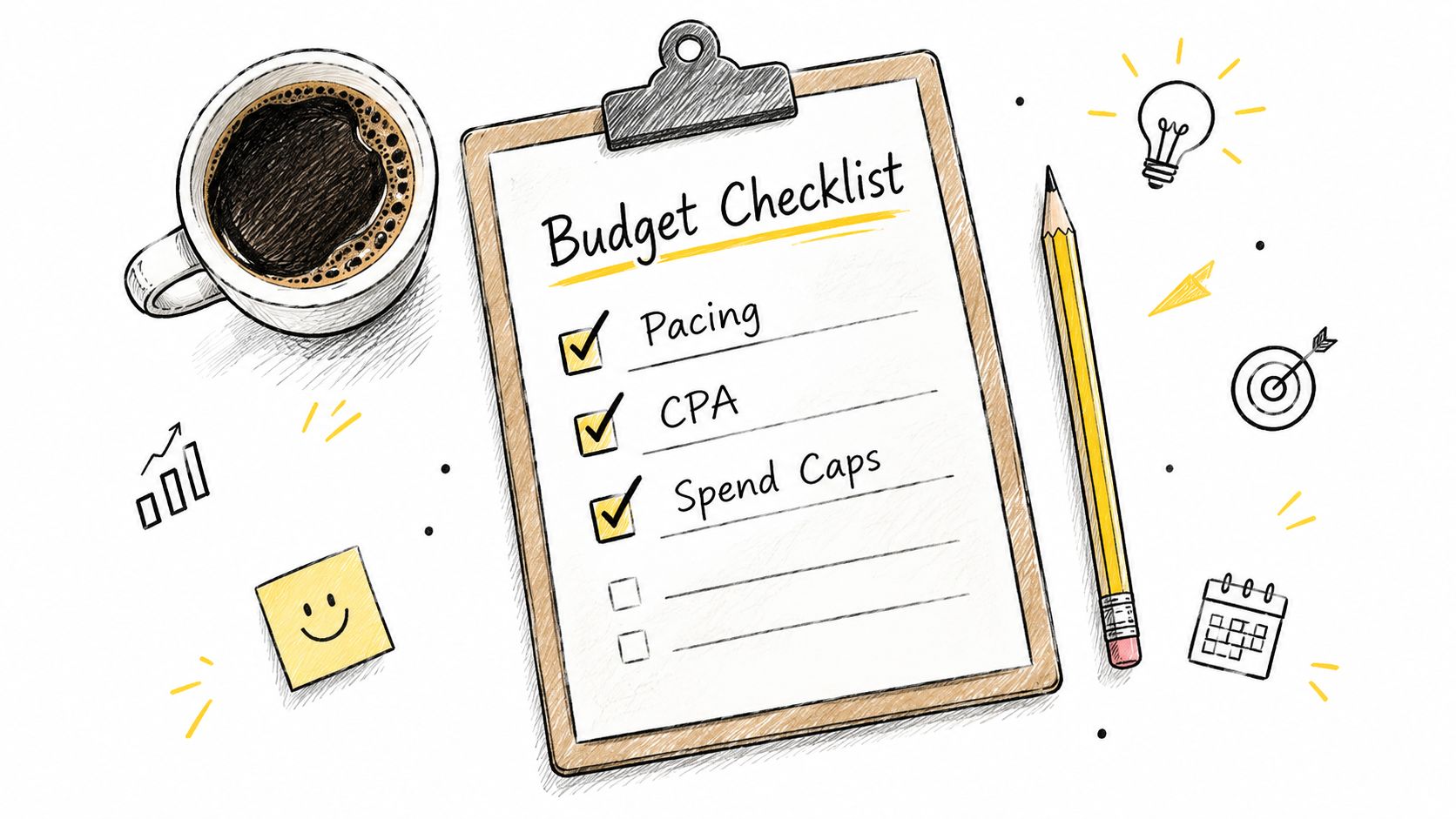
The most useful checklist is short enough to run every Monday and specific enough to assign. Start with account health, then examine efficiency, then approve only the changes supported by evidence.
Daily checks
- Pacing: Compare delivered spend with the planned curve and flag underdelivery or overspend.
- CPA drift: Check whether cost has moved outside the approved operating range.
- Frequency: Look for rising exposure paired with weakening engagement or conversion quality.
- Delivery status: Confirm that campaigns aren’t restricted by rejected ads, billing issues, exhausted budgets, or tracking failures.
- Rule log: Review automated actions and confirm that each change has an owner.
Weekly decisions
- Reallocation: Move only a controlled portion of budget when the receiving campaign has enough data and stronger marginal potential.
- Creative coverage: Refresh or rotate ads when fatigue signals appear, while preserving a control for comparison.
- Channel comparison: Reconcile platform-reported outcomes with CRM, revenue, and qualified conversion data.
- Experiment review: Decide whether each test should scale, continue, or stop based on its hypothesis and evidence threshold.
- Pacing correction: Fix delivery early rather than forcing a large end-of-flight adjustment.
Monthly and quarterly controls
- Allocation mix: Revisit the 70:20:10 split as the account matures and measurement improves.
- Measurement windows: Validate conversion windows, deduplication, and delayed outcomes.
- Scenario planning: Model what happens if spend shifts within a platform or across channels.
- Incrementality: Use holdouts or other causal tests to challenge platform-reported efficiency.
- Governance: Confirm that permissions, approvals, and permanent change records still match the team’s risk tolerance.
AdCrunch can centralize Meta, TikTok, and Google Ads data, connect campaign operations to agents, execute supported Meta budget and campaign actions, and retain a permanent activity log. That makes it one operational option for teams that want diagnosis, controlled changes, and accountability in the same workflow rather than separate dashboard and spreadsheet sprints.
Use this checklist on the next working day, assign an owner to every trigger, and record why each budget move happened. If you want a connected workflow for monitoring and executing ad operations across accounts, visit AdCrunch to review how the platform supports budget changes, campaign actions, and permanent activity records.